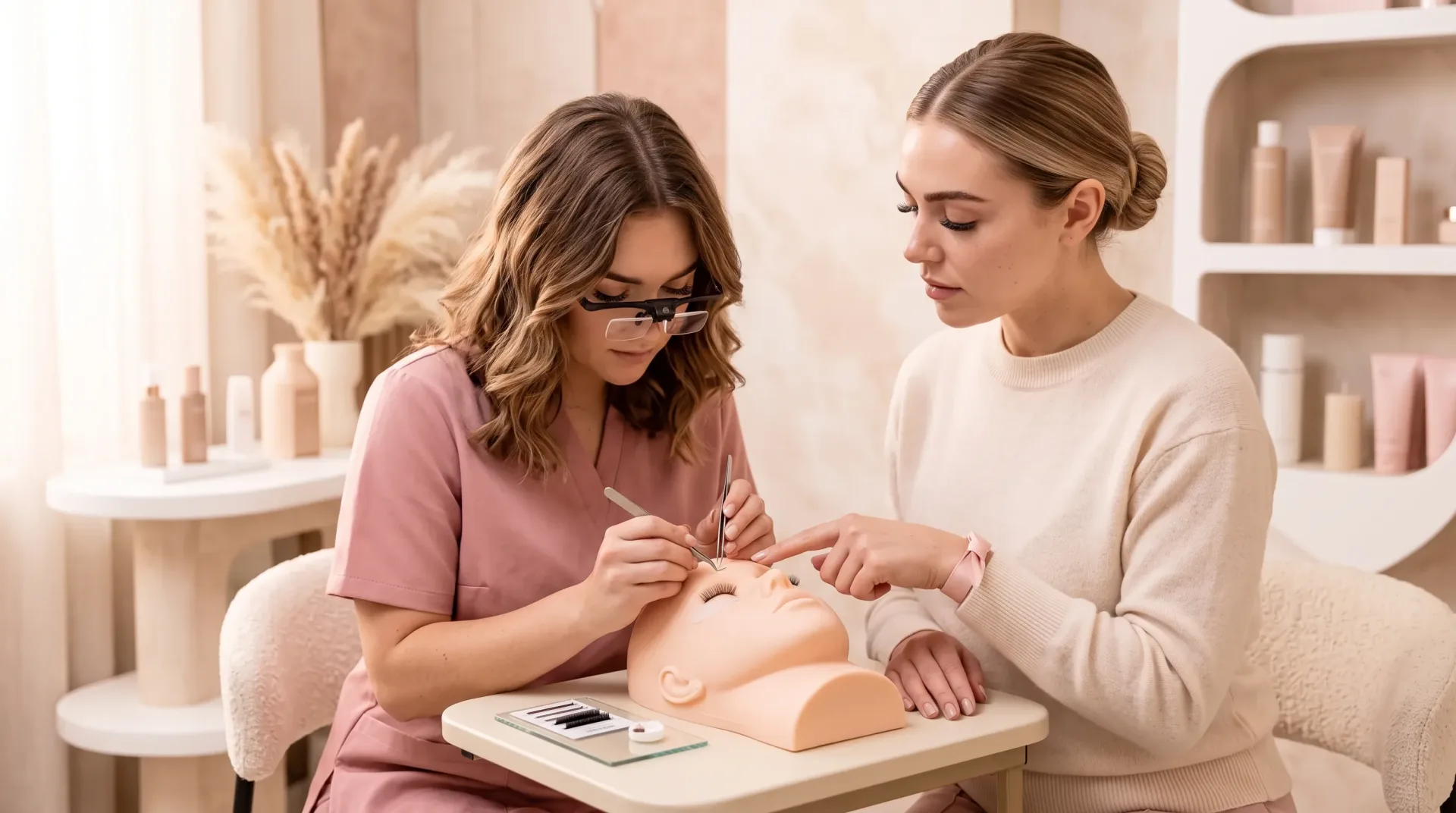
A lash extension course for beginners is where you start, and what you start with matters most. Good training gives a strong base, confidence and a technique that will not let you down. Before you sign up, it helps to know how a one day lash course differs from two day lash training and what each of them actually includes.
Why take a course at all
Is it worth signing up for a course and spending money on it? YouTube is full of training videos, there are detailed instructions. In the end, you can get your hand in on relatives and friends.
The answer is this: if you are serious about doing eyelash extensions on other people, you need to be trained in the craft. And it is not only about the certificate. On a course you take over the experience of a working artist right away and do not make silly mistakes at the start.
A lash artist is a technician, a stylist and a designer of the look. The artist pays attention to the individual features of the eyes, picks out the weak and strong sides, and places the accents correctly. The result depends on experience, on the number of techniques learned and on the quality of the materials.
One day or two days: how the formats differ
There are several ways to learn. Often experienced artists and studio owners build their own training programs. This option is good because the student chooses the artist whose work they have followed for a long time. The other option is a program spread over several days, with a deeper immersion in the profession, where several things are studied at once.
At our studio both formats are taught one-on-one in a real salon environment in Cranford, NJ. The One-Day Class is 8 hours with a 30-minute lunch break and gives a strong foundation for beginners. The Two-Day Intensive covers the same theory and adds volume basics, more live models and more one-on-one guidance. The full program of both is on the lash academy page.
| Format | Length | Live models | Price |
|---|---|---|---|
| One-Day Class | 8 hours, 30-minute lunch | 1 live model, plus mannequin | $850 |
| Two-Day Intensive | 2 days | 2 additional live models | $1,300 |
So how long is lash extension training? Here it is either one day or two. The difference is not in the theory but in hands-on time. The studio recommends the two-day intensive for the extra live-model practice.
What goes into a base course
Every school offers its own program, so look at what exactly is included in the course. The program should have not only basic theory but a practical part. The deeper and more structured the material, the less you will have to look for extra information afterwards.
In the one-day class this means full theory training, sanitation and hygiene protocols, choosing looks for facial features, the best brands and where to order them, hands-on practice with a mannequin, practice on one live model and classic basics. A starter kit, a training manual and a certificate of completion are included.
Hygiene gets a separate place for a reason. The workstation and tools have to be clean 200 percent. The client feels it at once, especially if she has already been to other artists. Tools are sterilized after every client, the mask, antiseptics and gloves are used, the bed, the lamp and the surfaces are kept in perfect condition.
Choosing a look is also theory. The artist looks at the shape of the eyes and the face before picking curl and length, and on the course this is shown on real examples, not only on paper.
Classic first, volume later
If you are only starting out, begin with the classic technique. It is considered the base, and learning it gives you an understanding of shape, curls, attaching and neatness. Do not rush into volumes.
Why this matters. You learn to work precisely and without hurry. You develop your hand and attention to detail. You lay the foundation for any technique that comes later. The differences between classic and volume sets are easier to understand once the classic is in your hands.
That is why the one-day class stays on classic basics. The two-day intensive adds volume basics and an extra focus on isolation, retention and speed, which are exactly the things that take time to set.
Mannequin and live model
Be sure to find out how the practice goes. Practicing on models is much more effective than working with the artificial lashes of a mannequin. The mannequin is needed to set the hand, but real lashes, a real eye and a person on the bed behave differently.
Check also whether the practice is supervised by an experienced artist. It is better when the teacher points out mistakes right away and makes corrections. Practice with feedback, where the work is checked and you can ask questions, speeds up learning a lot.
After the course, practice as often as you can. You want to learn quickly and well, then do lashes. Only practice will make you confident.
Where to find models? Offer the service to friends and acquaintances, do free procedures in exchange for a review, photograph every work for the portfolio. Use daylight or a ring lamp, shoot the lashes from different angles and edit minimally so the photos look natural.
Materials and the starter kit
Apart from the price of the course, find out whether extra spending on materials is needed or everything is included. Some courses give a set of materials for practice, and access to a manual and checklists. Both of our formats include a starter kit and a training manual.
Even at the start the materials should be good. They are the face of the artist, your reliability and the client's safety. You need good glue, tweezers, patches and brushes, materials from proven brands, ordered from suppliers with a guarantee.
For later work you will also need consumables: lash glue, remover, micellar water and a foam cleanser to remove dirt and makeup, patches for isolating the lower lashes, cotton pads, micro brushes, glue pads, a skin antiseptic, a solution for cleaning and disinfecting tools, disposable sheets and caps, a mask and gloves. The lashes themselves are needed in different lengths and curls, the base ones being C and D. It is better to start with short lengths, 5 to 7 mm, up to medium, around 16 mm, and to buy them in mixed-length trays.
For beginners a black glue with a slower set is usually recommended. It is harder to miss with it, and over time you can move to a faster clear glue.
Do
- Order from suppliers with a guarantee
- Sterilize tools after every client
- Start with C and D curls and short lengths
- Keep mixed-length trays
Do not
- Save on glue at the start
- Work without a mask and gloves
- Jump to volume before the classic is set
- Skip disinfection of the bed and lamp
After the course it continues
The industry does not stand still, and to stay at the top you have to update your knowledge. A lash artist should follow the trends, know new materials and techniques. It is a person who keeps leveling up as a specialist all the time.
What to do: take additional courses, study new mapping and techniques, experiment and try new products. Learning also does not end on the last day of class. After the course the studio stays in touch for questions, retention troubleshooting and product advice.
Many students come to the studio from nearby towns; Westfield, for example, is about five minutes from Cranford along North Ave.
In the end, the choice of a course depends on your goals, budget and expectations. The main thing is to find training that gives not just theory but prepares you for a confident start.
The one-day class gives full theory, classic basics and one live model. The two-day intensive adds volume basics and two more live models, and that is why the studio recommends it.

