Wax removes hair from the root, and the skin stays smooth longer than after a razor. But wax is not one product. Before a first bikini or Brazilian appointment it helps to know which wax goes where, what to do the day before and how to look after the skin afterwards.
First, sort out the terms
Epilation removes hair by destroying the hair bulb. Depilation does not touch the follicle. Wax, a razor, creams and sugar paste all count as depilation, even though in everyday speech people mix the two words up.
With wax the hair is pulled out together with the root, so the result lasts noticeably longer than with a razor or cream. The method also covers large areas faster. That is why waxing stays the usual choice for legs, underarms and the bikini area.
The wax itself is where the differences begin. The question of hard wax vs soft wax comes down to temperature, density and how the wax is taken off the skin.
Types of wax by temperature
Cold wax comes as strips or as a paste packed in jars. It is meant for use at home. Depilation with cold wax can often be painful and not very effective: the hairs are not pulled out with the root, they break.
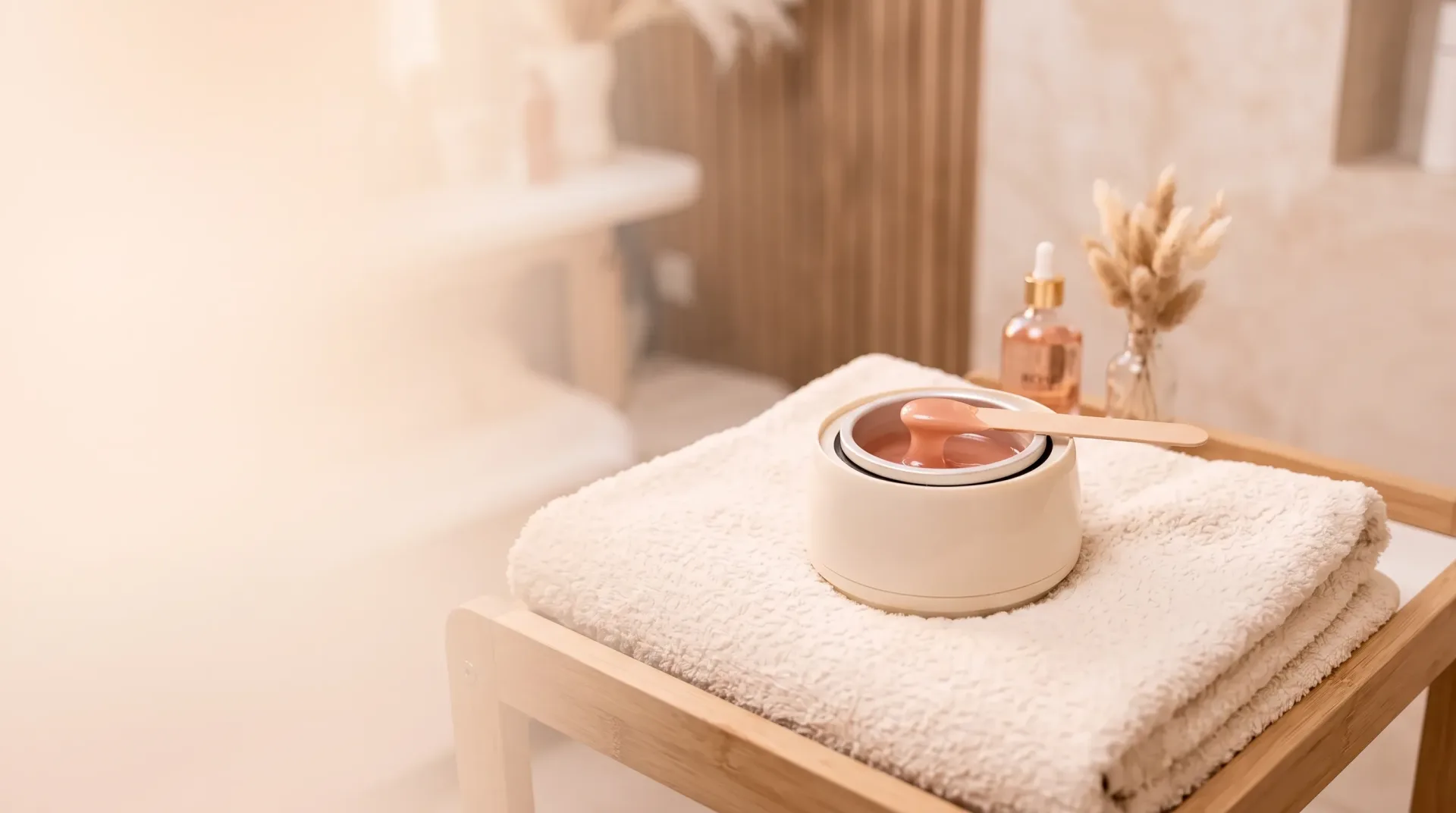
Warm wax is sold in rollers and cartridges and is heated in a special container. This is the soft, or strip, wax. It is spread in a thin layer and taken off with a strip of fabric or paper pressed on top. It is quite versatile and works on legs and arms.
Hot wax is the hard, or film, wax. With it depilation gives the best results, so professional artists use it in salons. It can be used in the bikini area and on the underarms. It sets on the skin as a firm film and is removed by hand, with no strips at all.
| Wax | How it is removed | Where it is used |
|---|---|---|
| Cold (strips) | Ready strip, pulled off | Home use, small touch-ups |
| Warm, soft (strip wax) | With a fabric or paper strip | Legs, arms |
| Hot, hard (film wax) | By hand, once it sets | Bikini, underarms, delicate areas |
Why the bikini area needs hard wax
For the bikini area granules — hard wax — fit best. The hairs there are thick and coarse, and to remove them you need hot wax or a product of high density. Hard wax is also the usual choice for small delicate areas, the underarms or brow waxing.
Strip wax is strictly not for the bikini area: there is a risk of tearing off the top layer of sensitive skin. Soft wax sticks to both the hair and the skin, and the strip pulls on both.
This is why the studio in Cranford uses hard wax only. It is heated to body temperature, so it wraps the hair and lifts it cleanly and is gentler on the skin. Hard wax grips the hair, not the skin, and it is applied and removed in small sections.
Among the hard wax benefits for a first appointment, this matters most: the skin is pulled less, and short coarse hairs are caught by the film instead of breaking off.
Plan everything in advance
Avoid massage, the bathhouse and hot baths right before the procedure — they make the skin more sensitive. It is better to give up a scalding shower and long hot soaks a few days before.
A scrub is best used 24 hours before depilation. Also try to skip body care products and the tanning bed for a day. If you used a razor before, stop shaving so the hair can grow out — for waxing it needs to be about 1/4 inch long, which is roughly 2 weeks of growth. With hair that is too short the result will not last as long.
If this is your first time after shaving, the sensations will be stronger. Fully getting rid of discomfort will not work, but it can be brought down to a minimum. Deep, even breathing helps.
How the wax is put on and taken off
The skin is cleaned and disinfected first, then treated with a little oil or talc. The wax is applied in the direction of hair growth in a thin layer, about 2–3 mm. On a hairless edge a small tab is left — a "lever" to take the wax off by.
The wax is removed against the direction of hair growth, moving parallel to the body. The skin is held taut the whole time. This lowers the pain and is safer for the skin.
The first time, depilation takes a bit longer. With each next visit the procedure takes less and less time, and the hairs become thinner and grow back slower. At the studio a Brazilian wax is $65 and takes 30 minutes; a full bikini is $47, 25 minutes; a bikini line is $35, 20 minutes.
Every appointment is in a private room, with one artist and the door closed, at your pace. Clients from Kenilworth come over too — it is about five minutes from the Cranford studio along the Boulevard.
Soft strip wax is fine for legs, but on the bikini area it pulls on the skin. Hard wax sets around the hair and comes off without taking the skin with it.
Aftercare and ingrown hairs
After depilation the skin is disinfected and a soothing panthenol product or aloe gel is applied. Do not use dense body creams, oils and butters right after depilation — they can create a compress effect and lead to inflammation. Wear loose cotton underwear for at least a day.
For 24 hours skip hot baths, saunas, sweaty workouts and direct sun. Do not use a scrub during the first day after depilation.
Ingrown hairs appear more often on very sensitive and dry skin. The skin type has more influence on them than the depilation method. Regular exfoliation keeps hairs from growing in: start gently from day three, and for delicate areas use soft products without abrasive particles. There are also special enzyme and acid products for preventing waxing ingrown hairs.
Keep the skin moisturised between visits and do not shave in between. Waxing on a regular four-week cycle softens the regrowth.
Do
- Wear loose cotton underwear for a day
- Use aloe gel or a panthenol product
- Exfoliate gently from day three
- Keep the skin moisturised
Do not
- Take hot baths or go to the sauna for 24 hours
- Work out hard or sit in direct sun the first day
- Put heavy creams, oils or butters on the area
- Shave between appointments