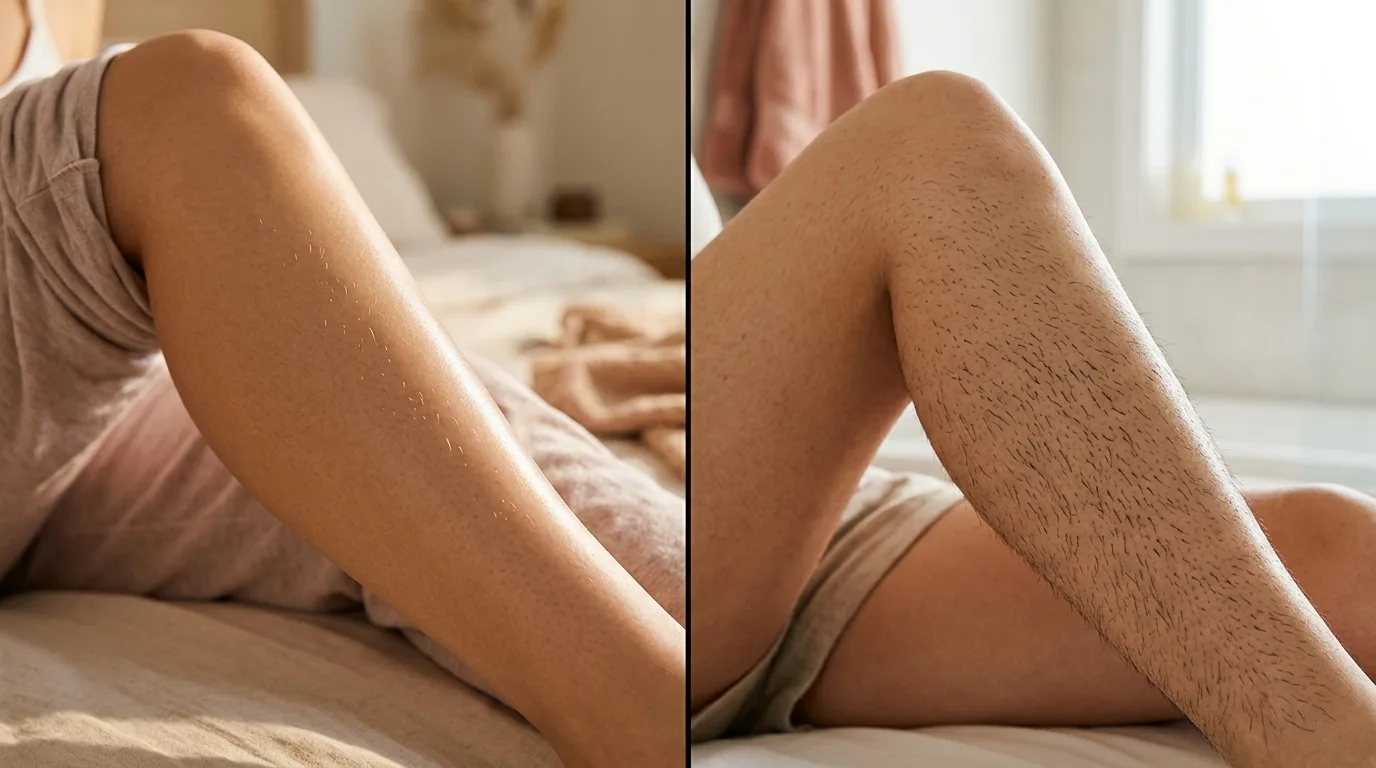
Every summer the same question comes back: how to remove hair so the effect lasts a long time and takes less effort. Many people try to get rid of hair on the parts of the body that will be on show before the cold weather returns: lower legs, underarms, the bikini area. Waxing vs shaving is the most common choice, and the two work in very different ways.
The main difference: surface cut vs root
What we see on the surface is the hair shaft, and inside the skin is the root, which includes the end of the shaft connected to the blood vessels and the follicle. The follicle wraps around the hair bulb and feeds its growth.
Shaving and waxing both leave the follicle in place: one cuts the hair at the surface, the other pulls it out with the root. Depending on the method, the hair starts growing again after some time. Methods that aim at the follicle itself, to stop the hair from growing for good, are a different group: laser, light, electrolysis.
Shaving takes off only the part of the hair that sits above the skin. Wax is applied in the direction of growth and removed against it, so the hair comes out together with its root. That is the main difference between the two, and everything else follows from it: how long the result lasts, what grows back and how the skin reacts. If you want the wider picture, the AAD's guide to removing unwanted hair covers the other methods as well.
Because these methods are simple and usually need no special equipment, all of them can be done at home. Still, waxing is the one people prefer to have done in a salon. Doing it yourself is not very convenient, although possible. It takes preparation, the right accessories and, most of all, a practiced hand.
How long each one lasts
Hair starts growing back very quickly after a razor, because shaving does nothing to the growth rate, it only cuts off the top. The first stubble shows up as early as the next day.
With wax, the shaft is also torn from the bulb, and growing a new hair takes a long time. On average, smoothness holds for three to four weeks. The catch is that between sessions the hair has to grow back to a length the wax can grip. Hair that is too short may not be picked up, and removal will be incomplete. For hard wax that means hair about 1/4 inch long, which is roughly two weeks of growth.
| Question | Shaving | Waxing |
|---|---|---|
| What is removed | Only the hair above the skin | The hair together with its root |
| Regrowth | Stubble as early as the next day | Smoothness for about three to four weeks |
| Hair length needed | None, you can shave any time | About 1/4 inch, roughly two weeks of growth |
| With regular use | Nothing changes in growth rate or structure | On a regular four-week cycle, regrowth comes in softer |
| Main risks | Cuts, irritation, dryness | Discomfort, redness, burns with poor technique |
So the short answer to how long waxing lasts is weeks, not days. Shaving buys you a day or two, and then it starts again.
Thicker or thinner regrowth, honestly
Does shaving make hair grow back thicker? Contrary to the popular opinion, shaving by itself affects neither the speed of hair growth nor its structure. These processes happen in the hair bulb, and a razor simply does not reach it.
Why does it feel thicker, then? Because the blade makes a straight, even cut. As the hair grows back, that blunt tip pricks, and you get a kind of stubble. The hair is the same, only its end is different.
Does waxing make hair grow back thinner? With regular sessions, the hairs become softer. In practice that is why a regular four-week cycle matters: regrowth softens when the visits do not break off.
One detail works against it. Shaving between visits blunts the hair, so instead of coming out cleanly with the root, it can snap. Then you are back to the short, prickly ends you were trying to get away from.
Stubble, ingrowns and bumps
Any hair can start to grow in, especially if the recommendations for the chosen method are not followed. Ingrown hairs appear when a hair cannot exit through the top layer of skin and grows under it or turns the other way. This can lead to local inflammation, and then a dermatologist may need to remove the hair.
In waxing vs shaving ingrown hairs can happen with both. With a razor, infections or scars often come from a blade that has not been changed for a long time; it is best to change it often. Irritation comes, for example, from shaving incorrectly, against the growth of the hair. With wax, ingrown hairs are also possible, and hyperpigmentation is often seen after rough, traumatic waxing. If wax is the choice, remember that it is applied with the growth and removed against it.
Curly hair carries a high risk of growing in, so proper skin care is a must. Waxing or shaving both suit it.
Do
- Use a sharp razor and shaving foam
- Shave in the direction of hair growth, not against it
- Keep the skin moisturized and exfoliate it
- Use soothing aloe gels if you feel inflammation or burning
Don't
- Shave dry
- Keep using a dull blade
- Put heavy creams and oils on the skin in the first days
- Leave an inflamed or painful ingrown hair alone; see a dermatologist
After shaving, the skin should be treated with moisturizer. After a more traumatic removal, it helps to treat the skin with an antiseptic and talc or powder. Heavy creams and oils are best avoided for the first days after hair removal, because they can clog the pores.
Pain, skin and the pros of shaving
Shaving is the simplest and fastest method, and it does not hurt. Its advantages:
- Simplicity. You need a minimum of supplies, and they can be bought in any store or drugstore.
- Effectiveness. Shaving gives the skin maximum smoothness, because the blade not only cuts the hair but also takes off dead skin particles on the surface. Together with hair removal you get a kind of peel.
- Availability. A basic shaving kit is cheap and sold everywhere.
- No long wait between sessions. Unlike other methods, you can shave even several times a day if you feel you need to. There is no need to grow out a certain length.
The downsides are just as clear: hair grows back very fast, the even cut makes regrowth prickly, regular passes of a razor can cause irritation, and there is still a risk of a cut. Too frequent shaving dehydrates the skin and causes dryness and flaking.
Waxing is considered one of the most effective methods, because the hair comes out together with the root part, and so the result lasts longer. It can be quite painful, but it all depends on the person's pain threshold. Waxing on the bikini area is felt more, since the skin there has many nerve endings. Everything that is offered sits on the full list of studio services, and brows have their own brow services page.
Razor to wax: the grow-out weeks
Switching from shaving to waxing starts with patience. How long to wait to wax after shaving? Long enough for the hair to reach about 1/4 inch, which is roughly two weeks of growth. These are the awkward weeks: the hair is visible, and you should not reach for the razor.
The downsides of waxing should be said plainly. Regular salon visits cost money and have to be repeated. Between sessions the hair has to grow out. Hot wax can cause burns if the right technique is not followed. Ingrown hairs are possible, and waxing is no less painful than a mechanical epilator. If you have a skin condition in a flare-up, open wounds, a rash or a fresh tan, ask your esthetician before booking. Tell your esthetician and your doctor about every medicine you take, retinoids included, because some make the skin more sensitive.
The pros of waxing are a long result, rare ingrown hairs when the technique is right, use on many body areas, and softer regrowth on a regular cycle. Is waxing better than shaving? For speed and zero pain, no. For weeks of smoothness and softer regrowth, yes.
Shave if you need smooth skin today and do not mind doing it again tomorrow. Wax if you can wait out two weeks of growth and then keep a four-week rhythm. A Brazilian is $65 and takes 30 minutes, a bikini line is $35, a full bikini is $47.
If you are choosing between hard and soft formulas, read our guide to hard vs soft wax first. You can find directions from Union, NJ or see all the towns we serve. Questions before a first visit go through the contact page for the studio, and more about the team is on the about the studio page.