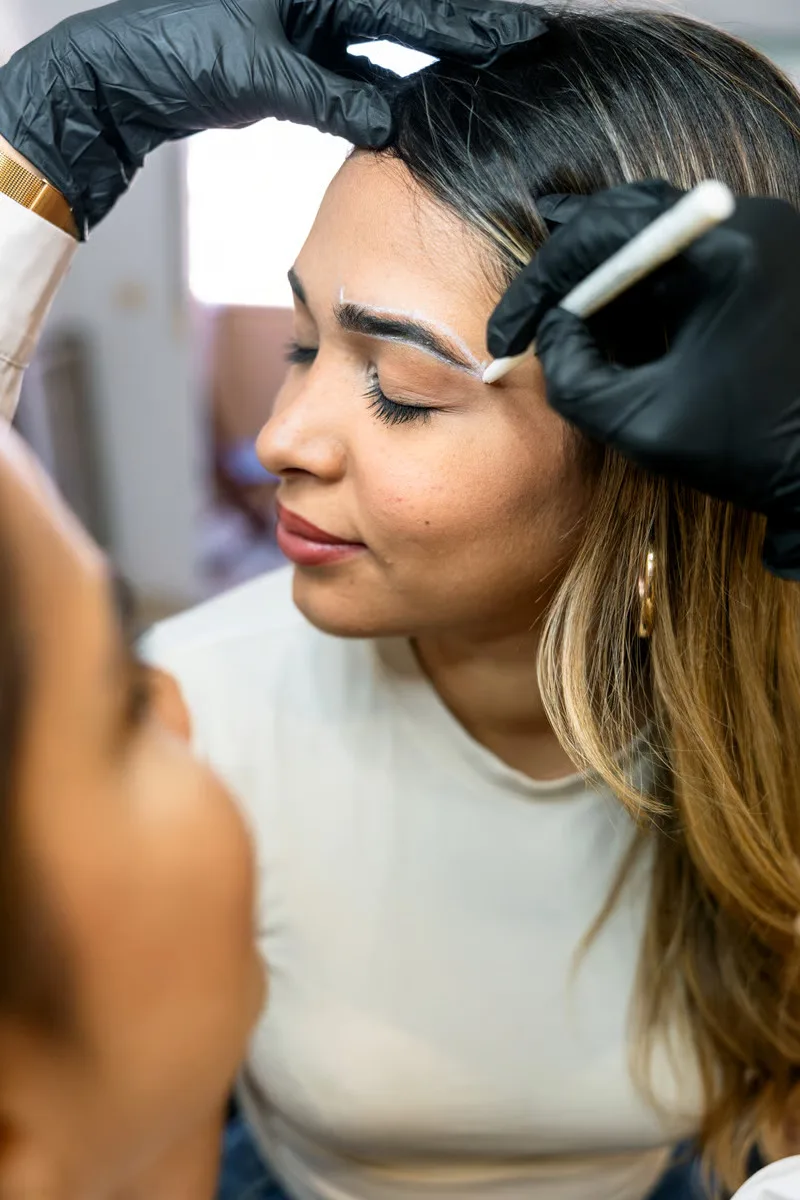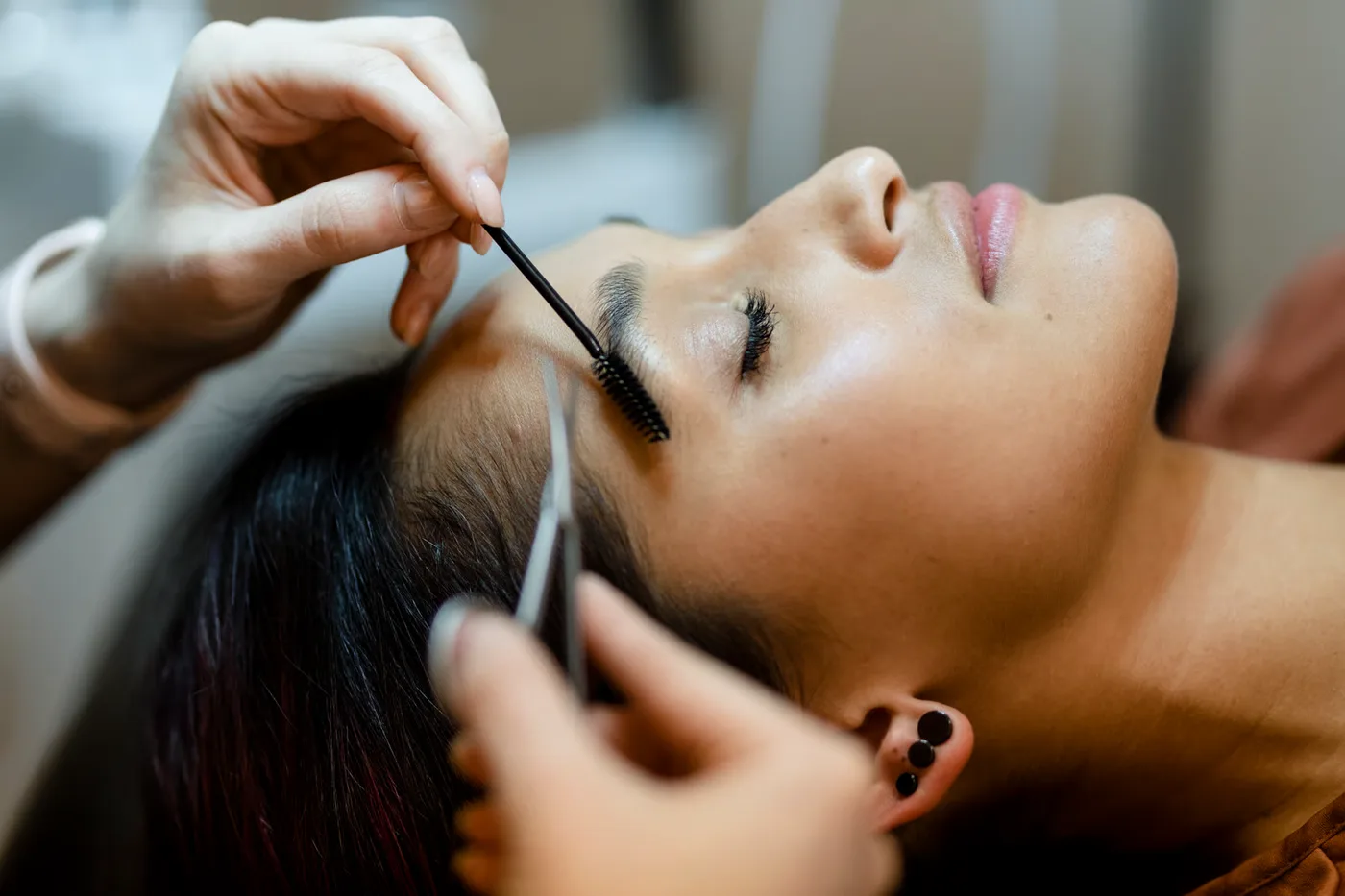
Brow architecture starts with the face, not with the tool. A brow artist looks at hair growth, symmetry, where the eyes sit and what makeup the person usually wears. Only then the shape and thickness are chosen, and only then it is decided what to work with: tweezers, thread or wax. Each method has its own technique, its own sensations, its own precision and its own demands on the skin. Shaping should not be rushed. Careful, point-by-point work gives the best result.
How each method works
Tweezers are the classic method and the most precise one. Hairs come out one at a time. In a salon tweezing usually goes together with marking tools, and a soothing product is put on afterward. A straight, slanted or pointed cosmetic tweezer is used.
Eyebrow threading is a mechanical method with no chemicals at all. A cotton thread is tied into a closed loop and twisted between the thumbs and index fingers of both hands. Two triangles form, with the twisted part where they meet. The fingers move the twist left and right, so one side of the triangle opens while the other narrows. When the thread travels against hair growth, the hairs tangle in the twist and are pulled out quickly, several at once. It looks simple. In practice it needs the right tension, the right angle and an understanding of which way the hair grows. Some artists hold the thread with hook holders. Before threading, brows are often brushed against the direction of growth so the thread catches more easily.
Wax removes hair with a warm product or with strips. In salons it is typically used to clear the area under and above the brow, the temples and sometimes the bridge of the nose, and the shape is then finished with tweezers. There are three kinds of brow wax. Hot (hard) wax comes as solid beads that turn liquid when heated; it is considered suitable for sensitive skin and is removed without strips. Low-temperature cartridge wax is applied in the direction of hair growth. Cold wax strips are warmed between the palms before use. Our studio works with hard wax only - the difference is laid out in our post on hard wax versus soft wax explained.
Precision: what each one removes
With tweezers you can take out a single hair and not touch the ones next to it. The shape is easy to fit to the proportions of the face. It is also handy for tidying a brow after tinting, when density has to stay as it is. Good tweezers are not expensive and let you keep the shape between salon visits. The downside: each hair is pulled separately, so it is slow, and large areas take a long time. At home, the wrong angle or over-thinning leaves gaps. Cheap tweezers often break the hair instead of pulling it out. You need good light, a mirror and a steady hand.
Thread removes fine vellus hair that tweezers have trouble gripping - almost any hair type and size, including peach fuzz. Several hairs come out at once, which saves time. It can be paired with tweezers: thread for the contour, tweezers for single strays. Controlling the thread at the arch is hard, though. It takes exact, practiced movements and a lot of concentration. People who try it for the first time often end up with uneven results.
Wax clears larger areas in one pass. It catches coarse hair and some fine hair, and good wax grabs even very short hairs. The edge comes out neat and the base under makeup is smoother. But here precision matters most.
That is why wax is usually not the last tool. Waxing near the brow clears the area, and tweezers do the final shaping. Face and body waxing are on our face and body waxing page.
Skin, retinoids and acne medicines vs wax
Wax takes a thin layer of the skin's surface along with the hair. Skin can turn red or stay sensitive afterward, especially if it is thin or dehydrated. Common reasons to skip wax are irritation, a fresh sunburn or tan, cuts and active inflammation. Allergy to wax ingredients and taking retinoids also go on the list. Retinol already removes a lot of surface cells by itself, so wax on top of it can be very traumatic for the skin. The American Academy of Dermatology gives the same warning in its hair removal tips: people using retinoids or certain acne medicines should talk to a dermatologist before waxing. At our studio, no retinol goes near the brows for 48 hours before a wax.
Thread does not touch the skin the way wax does, and nothing is glued onto it. This is why thread is often suggested to people who react to wax or other products. But threading also has limits. It can sting more than expected on thin skin or after a recent peel. Wrong technique stretches the skin and leaves redness, and if the thread catches skin together with a hair, there can be a bruise. Skin with irritation, micro-damage or inflammation should not be threaded either - another method is better. Moles, warts and scars in the area, and a recent brow tattoo, are also reasons to skip threading there.
Tweezers, done right, irritate the least and do not damage the upper layer of the skin. Even so, for very sensitive skin they are not ideal, simply because every hair is a separate pinch.
After brow hair removal
- Moisturize the brow area daily with a gentle, fragrance-free cream.
- Cool the area with a cold compress if it stays red.
- Use SPF before going outside.
For the first 24 hours
- Don't touch or scratch the treated area.
- Don't put makeup or skincare right on it.
- Skip direct sun, heat, heavy sweating, chlorinated pools and hot tubs.
Pain: what it feels like
With tweezers it is a series of small pinches. The sensation is high because each hair is pulled on its own, and with a full shape there are a lot of them.
With thread, strong pain is not typical. Most people feel discomfort, and it is short, because the work is fast. How much it hurts depends on the pain threshold and on how sensitive the skin is. The more skilled the artist, the faster and less painful it is. Some people put threading off right before or during their period, when sensitivity is higher.
With wax, it again comes down to personal tolerance. For some it is less comfortable than tweezers or thread. Temporary redness, swelling or irritation can follow. The risk of side effects depends on how sensitive the skin is, the quality of the wax and the experience of the person doing it.
How long results last and how often to book
Thread and wax both pull the hair out with the root, so the clean look lasts longer than after anything that cuts hair at the surface. After wax, the first visible hairs usually come back in 2-4 weeks. The exact time depends on hormones, the season, how dense the hair is and how long a person has been waxing. With regular waxing the intervals stretch to three to six weeks, and hairs tend to grow back slower and finer. After threading, hair in the treated spot usually stays away for about a month.
So how often should you get your eyebrows waxed or threaded? Roughly:
- Tweezers: upkeep every 7-14 days, if you only pull single hairs.
- Thread: usually every 2-4 weeks, because more hairs come out per session.
- Wax: usually every 3-5 weeks, especially for a full wax shaping that clears the area around the shape.
Booking threading back to back, more often than the hair actually grows, is not a good idea. Wait until there is something to remove: threading does not work when hairs in the area are shorter than about 1/8 inch, because the thread cannot catch them.
The more area you clear at once, the longer the clean look lasts - and the more the technique and precision matter. Tweezers keep the shape between visits; thread and wax set it.
Thin vs thick brows, and why shaping uses all three
So is waxing or threading better for eyebrows? It depends on the hair. Tweezers suit people with very dense, thick hairs, and they are the tool for targeted work. If the brows are soft and what grows outside the shape is light down, wax or thread can be used without worry. Thread works best on fine hair and light fuzz and may not do much on very thick, coarse growth. Wax is described as universal, and it is especially effective for thick, coarse, fast-growing hair.
Thin or sparse brows need the most caution. Natural volume looks better than a perfect line, and very thin, over-plucked brows tend to make the face look stricter and older. Good shaping removes only what breaks the shape and keeps the brow's own density. Over-plucking the inner start makes the eyes look set wider apart; a tail cut too short throws off the balance. This is why the face is mapped first and the shape is marked before anything is removed.
| Method | Suited to | Watch out for |
|---|---|---|
| Tweezers | Targeted shaping, upkeep between visits, thick dense hairs | Slow on large areas; easy to over-thin if careless |
| Thread | People who react to wax, a sharp contour, fine hair tweezers can't grip | Can sting on thin skin; uneven in unpracticed hands |
| Wax | Clearing larger areas fast, coarse and fast-growing hair | One wrong pull costs the shape; redness; more contraindications |
| All three together | A full shape: wax or thread clears, tweezers finish single hairs | Needs the face mapped and the shape marked first |
That last row is how custom shaping works. Wax or thread clears the area around the shape, and tweezers take out the single hairs that are left. At our studio, threading is $16 (15 minutes), an eyebrow wax is $25 (20 minutes) and tweezing is $35 (25 minutes). Custom shaping, $45, combines shape, wax, tweeze and trim. All of them are listed under our brow services and shaping options, and the rest of the menu is on the full list of services.
If you are weighing brow lamination vs threading, those do different jobs: one removes hair, the other sets the hairs that stay. That comparison is in our guide on lamination, henna or tint for brows.
Anyone who has not had professional brow work before is better off starting with a brow artist, who sets the shape and shows how to keep it up. You can read more about our Cranford studio, find directions for clients coming from Kenilworth, or send a question through our contact page.